

H1B Visa Process: Step-by-Step Application, Lottery & Approval Timeline
The H1B visa is a type of U.S work visa for foreign professionals with specialized skills to work in the United States, by allowing the employers to give work to foreign workers in specialty occupation of fields such as information technology, engineering, finance, healthcare, and research with at least a bachelor’s degree in it. These employers mostly depend on this visa to fill the talent gaps which are critical in U.S.
Here’s everything you need to know about the process, requirements and salary from the H1B visa’s lottery registration to final approval by the U.S. Citizenship and Immigration Services (USCIS).
H1B Visa Requirements World-Wide
All over the world, the H1B visa has the same qualification standards for everyone. The best thing about this visa is that you will not find any country-based preference, restriction, or quota in the H1B Visa Requirements for Indians to meet.
Checklist for H1B Visa Eligibility
To be eligible for an H1B visa, you must follow this checklist where the various options of H1B visa eligibility requirements include:
Educational Background: This includes various options like a bachelor’s degree or higher (or equivalent) in the occupational specialty field; or based on the specialty occupation an unrestricted state license/certification; or simply recognized work experience in the specialty organization.
Job offers: You must be accepted in job position requiring theoretical and practical application of highly specialized knowledge in fields like IT, engineering, healthcare, finance, mathematics, or science
Employer sponsorship: H1B visa can’t be applied independently; U.S. employer must sponsor your visa through Form I‑129 Petition once their Labor Condition Application (LCA) is filed and certified.
Specialty occupation: For the job role, specialized knowledge is required typically from a bachelor’s degree or higher in occupation specific field
Prevailing wage: The employer must pay you at least the average wage for your occupation which is common in the work-based area by getting a certification of wage protection from Labor Condition Application (LCA)
Required H1B Visa Documents by Employer and Employee
For the H1B visa process to be approved, it requires large documentation at multiple stages from both the employer and employee. Here’s a list of H1B visa documents required by USCIS for both:
Employer-Specific H1 B Visa Documents
Form I-129 Package:
- Form I-129 Petition which is an official application that a U.S. employer files with USCIS to sponsor a foreign worker’s H1B work visa
- Labor Condition Application (LCA) from Department of Labor (DOL) which is a document that a U.S. employer must file with before submitting Form I-129 Petition. Its purpose is to show fair treatment of foreign employees under U.S labor standard wage protection and working conditions.
- Job offer letter with details such as position, duties, salary, and work location
- Company organizational chart showing where position fits
- Proof of employer’s ability to pay through documents of tax returns, financial statements, bank statements
- Proof that the position to hire the employee is of specialty occupation like in fields of IT, engineering, healthcare, finance, mathematics, or science
- Company registration documents which include business licenses or articles of incorporation which are legal documents filed with a state government to officially create a corporation.
Employee-Specific H1B Visa Documents
Form DS-160: confirmation page which is the online work visa application form mandatory to be submitted for H1B visa process.
Educational Documents:
- Certificates of bachelor’s or higher degree in specialized field
- Academic transcripts from university with list of subjects or courses studied, overall results with name of the institution and duration of study
- Degree evaluation report converting foreign education into U.S equivalent education system
- Specialty occupation licenses or certifications (if applicable)
Beneficiary’s Qualifications:
- Detailed resume or CV
- Letters from previous employers documenting work experience
- Professional certifications, awards, or publications
- Evidence of specialized training or skills
The Visa Depot’s Step-by-Step Application Guide of H1B Visa Process
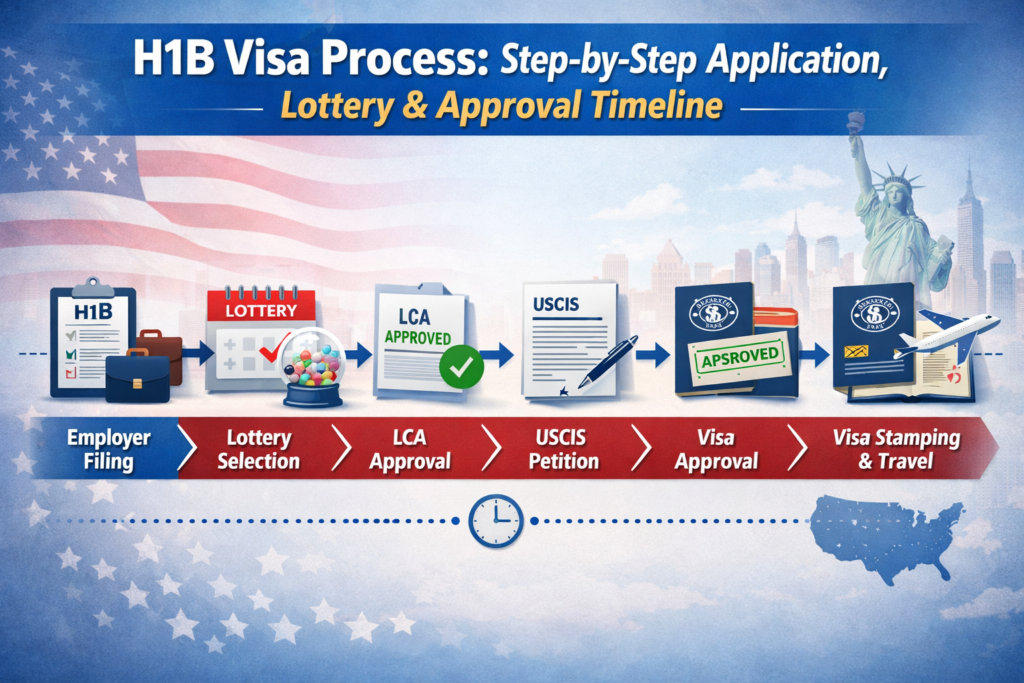
Step 1: Get an Employer Sponsorship
The U.S. employer sponsors your H1B visa with a job offer in a specialty occupation. H1B visa can’t be applied to your own sponsorship.
Step 2: Register your H1B Visa Application online for Lottery Registration
Every H-1B visa entry requires H‑1B electronic registration during USCIS lottery entry period, which is usually in March. The employer’s representative visa consultancy registers personal and official information of both employer and nominee (employee).
Nominee-Centric Selection: By nominee-centric selection, we mean that each person will receive only one lottery entry regardless of how many employers register for them so that everyone has a fair chance without any duplicate entry.
Step 3: Selection of Nominee by the Lottery
USCIS conducts the lottery, usually within a week or two after the registration period ends, often by late March or early April. The lottery uses a two-stage process:
- First lottery: 65,000 regular cap positions (all degree holders compete)
- Second lottery: 20,000 positions for unselected U.S. master’s degree holders
Step 4: Filing Labor Condition Application (LCA)
After lottery selection, your employer will file an LCA with the Department of Labor (DOL). The LCA makes sure that employees get a fair salary and working conditions. DOL takes about seven days to process this application, that’s why you should file it early for the certification to move forward with petition.
Step 5: Filing Form I-129 Petition
Once the LCA is certified, employers can submit Form I-129 petition to USCIS, along with the certified LCA which has the basic employee-specific documentation of their qualifications, and proof of job role qualifying as a specialty occupation.
Step 6- Receiving USCIS Approval Notice of Action by Form I‑797
Once your Form I-129 Petition is approved by USCIS, they issue Form I‑797. This confirms your H‑1B visa
- Processing by consulate: If you are outside the U.S., a visa interview at a U.S. consulate or embassy is scheduled where you have to submit documents like your passport, confirmed DS‑160 visa application form, I‑797 approval notice, and supporting documents mentioned above.
- Visa Stamping: Upon successful interview, the consulate will physically stamp your H‑1B visa in your passport.
- Entry to the U.S.: At the port of entry, you have to present your visa and approval notice so you can travel and work in U.S.
For those already in the U.S. with another visa, the USCIS will change the status of your visa to H‑1B with approval, so you can start working from the effective date without requiring consulate stamping or processing.
The H1B Lottery Process
Greater demand than availability for H-1B visas, so the H1B work visa USA uses a lottery system to help create fairness.
Lottery Draw is conducted within 1–2 weeks after registration closes which is late March or early April.
Selection Process:
- First lottery: 65,000 regular cap positions (all degree holders compete)
- Second lottery: 20,000 positions for unselected U.S. master’s degree holders
First the special cap lottery takes place for those with U.S master’s degree then who are not selected get another chance to be selected in regular cap. This means U.S. master’s degree holders get two chances, while others get one.
Selection Rates:
In 2025, USCIS selected 114,017 single entry nominees, when 120,603 were registered through H-1B registrations during the first round of 2025 H-1B Lottery, which therefore represents a selection rate of approximately 25.6 percent.
In the second round, an additional 13,607 nominees were registered, resulting in 14,534 selections, making an overall total of 135,137 which is about 30% selected registrations for 2025 H1-B Lottery.
Processing Times
Once selected, the employer files Form I‑129. Processing times depend on the processing service chosen:
- Standard Processing: 3-6 months after petition filing
- Premium Processing: With premium processing, USCIS guarantees processing the petition within 15 days for an additional $2,805 after fee request and payment.
H1B Visa Duration & Extensions
- Initial approval is up to 3 years
- Maximum stay is of 6 years
- Extensions are possible during green card processing
Job Change & Green Card Pathway
- H1B transfers are allowed without a new lottery
- Dual-intent visa allows pursuit of permanent residence
- Common PR pathways include EB-2, EB-3, EB-1, and NIW
H1B Visa Salary Limits
There is no fixed national maximum or H1B minimum salary in the USA. The wages depend on occupation, job location, and experience level. Although the salary must meet U.S. Department of Labor (DOL) standards of prevailing wage for H1B visa.
Actual Wage vs Prevailing Wage for H1B visa Rule
The employers must pay the higher of actual wage which is paid to similar employees in the same role. Whereas the prevailing wage is according to the average wage for the occupation in the same geographic area.
H1B minimum salary in USA
- Statutory minimum salary is USD 60,000 per year
- Many roles require higher pay due to local wage standards
- High-cost regions and senior roles typically exceed this minimum
Categories of Wage Levels (Level 1–4) assigned by Department of Labor (DOL) based on Work Distribution
- Level 1 (Entry-Level): Routine duties are assigned with close supervision by senior
- Level 2 (Qualified): Duties with moderate complexity are assigned with limited supervision
- Level 3 (Experienced): Complex tasks are assigned with minimal supervision
- Level 4 (Senior): Expert leadership or supervisory roles are assigned
Wage-Based Lottery Selection Priority
- Higher salary levels receive lottery preference
- Selection order is set by levels of DOL: Level 4 → Level 3 → Level 2 → Level 1
- There is no maximum salary cap although employers may pay above prevailing wage
H1B Employer Requirements
There are certain guidelines to be followed for H1B job offer requirements when selecting the specialty occupation H1B. This helps in job security of the applicants and work authorization leading to transferring their H1 B visa for PR pathways.
Obligations of Basic Sponsorship to H1B job offer requirements
- Must be a U.S. employer or authorized U.S. agent
- Must offer a valid specialty occupation position
- Must establish a genuine employer–employee relationship
Mandatory Filings
- File Labor Condition Application (LCA) with the DOL
- File Form I-129 petition with USCIS
Wage & Payment Compliance
- Pay the required wage throughout the entire employment period
- Wages must be paid on time and in full
- No unpaid benching allowed
Fees & Financial Responsibility
- All H1B filing fees must be paid by the employer
- Fees cannot be passed on to the employee
Recordkeeping & Transparency
- Maintain documentation for wage determination and job duties including LCA postings and payroll records
- Allow public access to files for inspection
Reporting Changes & Termination
For amended petitions required for job location changes, significant role changes or salary reductions
- Employers must notify USCIS and DOL upon termination
- Must offer return transportation costs
Startups & Small Businesses
- Should be eligible to sponsor H1B workers
- Must demonstrate financial stability and ability to pay wages
Dependents & Work Authorization
- Spouse and children are eligible for H4 visas
- Some H4 spouses may qualify for work authorization (H4 EAD)
Conclusion
In 2025, employers filed at least 423,028 eligible H-1B registrations, but USCIS could only allow 85,000 new foreign nationals to obtain H-1B status under the annual limit, an approval rate of only 20%
The H1B visa remains highly competitive but achievable with proper document preparation, strong employer support, and strategic planning. There is no doubt that the country gives more preference and special dedicated lottery selection for U.S based students. One should consider consulting visa experts for other work visa options and cap-exempt positions while they complete their higher study in U.S.A to maximize their chances of working through other available pathways in the United States.
FAQS
1.What is the H-1B visa requirements?
To qualify for an H-1B visa, you must have a job offer from a U.S. employer, hold at least a bachelor’s degree or equivalent in a related specialty field. Along with this, your employer must file an approved Labor Condition Application (LCA) and H-1B petition with the USCIS.
2.What is the minimum salary for an H-1B visa?
There is no fixed minimum salary for H-1B visas. Employers must pay the statutory salary is of USD 60,000 per year but among prevailing wage or the actual wage whichever is higher is to be paid, based on the job role, experience level, and work location in the U.S.
3.Are H-1B visa requirements different for Indians or Canadians?
No. H-1B visa requirements are not country-specific. But the processing timelines and visa stamping procedures can be different for different countries.
4.Can you enter more than for H1B visa lottery selection?
The H1B visa lottery selection is held in two rounds. First the special cap lottery takes place for those with U.S master’s degree then who are not selected get another chance to be selected in regular cap. This means U.S. master’s degree holders get two chances, while others get one. But only one employer can enter one nominee.