

Study in Canada to PR: Complete Roadmap for International Students in 2026
Deciding to study in Canada is one of the most effective ways for international applicants to build a long-term immigration pathway. For many students, Canadian education provides access to valuable work experience and eventually permanent residence. In 2026, the transition from education to immigration has become more structured, but it also requires careful planning.
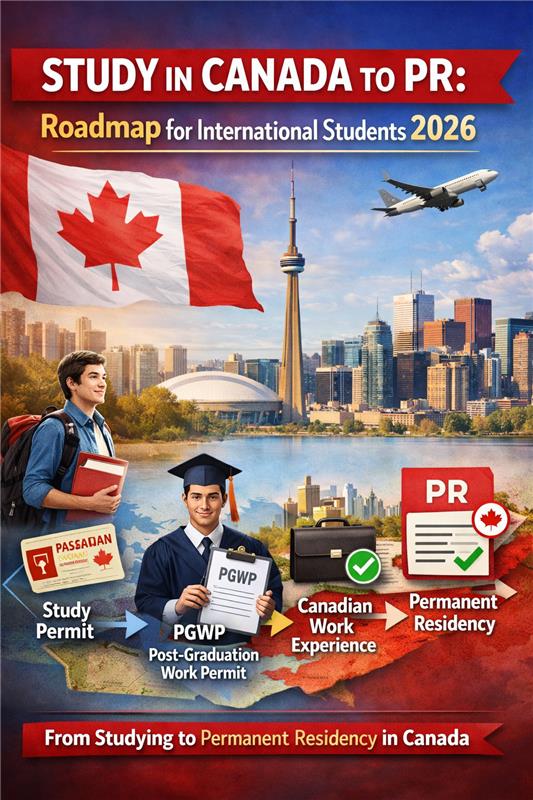
The pathway from student visa to permanent residency typically includes a study permit, a post-graduation work permit, skilled Canadian work experience, and finally an application for permanent residence. Because policies are frequently updated, applicants exploring Canada immigration for students must understand how each stage works before choosing a program or institution.
This guide explains the full journey — from deciding to study in Canada to applying for PR after study Canada — along with the latest 2026 immigration rules and program updates.
Post-Graduation Work Permit: The Key Step After You Study in Canada
The Post-Graduation Work Permit (PGWP) is the main bridge between completing your education and applying for permanent residence. It allows graduates of eligible Designated Learning Institutions (DLIs) to work in Canada for up to three years.
For students planning PR after study Canada, the PGWP is critical because it enables them to gain the Canadian work experience required for most immigration programs.
Degree vs Diploma Programs
Students who study in Canada through university degree programs — such as Bachelor’s, Master’s, or PhD — generally face fewer restrictions when applying for a PGWP. Any field of study can qualify as long as the institution is PGWP-eligible.
However, diploma and certificate programs have additional requirements. These programs must align with specific fields identified by the Canadian government as labor-shortage areas. The program’s CIP code must appear on IRCC’s list of approved programs.
Approved sectors currently include:
- Healthcare and social services
- STEM fields
- Skilled trades
- Transportation
- Agriculture and agri-food
- Education
Before enrolling, many students consult a Permanent Residency Consultant to confirm that their chosen program supports their long-term PR after study Canada goals.
Language Test Requirement for PGWP
Another major update affecting Canada immigration for students is the mandatory language requirement for PGWP applicants.
Students must now submit approved language test results when applying for the PGWP.
Minimum requirements include:
- CLB 7 for Bachelor’s, Master’s, and PhD graduates
- CLB 5 for diploma or certificate graduates
Because language testing centers often have limited availability, many experts recommend scheduling tests several months before graduation.
Master’s Programs Offer a Strong Advantage
Canada immigration for students planning PR after study Canada, master’s programs remain one of the strongest pathways.
Graduates of master’s programs are eligible for a three-year PGWP even if the program duration was shorter than three years, provided it lasted at least eight months.
This extended work permit gives graduates more time to gain skilled work experience needed for immigration programs under Canada immigration for students.
PR After Study Canada: Immigration Pathways for Graduates
After completing their education and gaining work experience, graduates can apply for permanent residence through several programs.
These pathways form the backbone of Canada immigration for students.
Canadian Experience Class (CEC)
The Canadian Experience Class under Express Entry is one of the most popular routes for graduates pursuing PR after study Canada.
To qualify, applicants must:
- Have at least one year of skilled Canadian work experience
- Work in occupations classified under TEER 0, 1, 2, or 3
- Gain the experience after graduation
Work completed while studying full-time does not count toward eligibility.
Because eligibility requirements can be complex, many applicants work with a Permanent Residency Consultant to ensure their work experience meets immigration criteria.
Express Entry Category-Based Draws (2026)
Canada introduced new category-based draws to better target labor shortages.
Priority categories now include:
- Healthcare professionals
- Researchers and academic workers
- Senior managers
- Transportation occupations
- Skilled trades workers
Students who study in Canada and gain work experience in these sectors may have stronger chances of receiving invitations for PR after study Canada.
Provincial Nominee Programs for Graduates
Provincial Nominee Programs (PNPs) offer another important pathway under Canada immigration for students.
A provincial nomination adds 600 CRS points, significantly increasing the chances of receiving an invitation for permanent residence.
Popular graduate streams include:
- Ontario Masters Graduate Stream
- Ontario PhD Graduate Stream
- British Columbia International Graduate Stream
- Saskatchewan Graduate Retention Program
- Alberta graduate pathways
Graduates who study in Canada in provinces with strong PNP programs may find this route particularly effective for securing PR after study Canada.
Canada Immigration for Students: Step-by-Step Roadmap
Understanding the full process helps students plan their immigration journey more effectively.
Step 1: Choose the Right Program
The first step is selecting a program at a PGWP-eligible DLI (Designated Learning Institution).
Students planning PR after study Canada should prioritize programs linked to in-demand category-based draw occupations. If applying to a college diploma program, confirm the program’s exact six-digit CIP code is on IRCC’s eligible list. A Permanent Residency Consultant can help confirm program eligibility before applying.
Step 2: Apply for a Study Permit
Applicants must obtain a study permit before they study in Canada. Applicants whose study permit application was submitted before November 1, 2024, are exempt from the field-of-study PGWP requirement for any program.
As processing times vary depending on country of residence, and Canada’s study permit caps introduced in recent years make early applications essential.
Step 3: Maintain Student Status
To remain eligible for the PGWP and future Canada immigration for stude
nts’ programs, students must maintain full-time enrollment. At least 50% of study must be completed in-person in Canada for study permits issued after August 31, 2024.
Step 4: Apply for the PGWP
Graduates must apply for the Post-Graduation Work Permit within 180 days of receiving final grades.
This permit allows graduates who study in Canada to gain the skilled work experience required for PR after study Canada.
Step 5: Gain Skilled Canadian Work Experience
Work experience gained through the PGWP must be in skilled occupations classified under TEER 0–3.
At least 12 months of skilled work experience is typically required before applying for permanent residence.
Step 6: Create an Express Entry Profile
Once work experience requirements are met, candidates can create an Express Entry profile or explore provincial nomination options.
A Permanent Residency Consultant can evaluate whether Express Entry or a PNP provides the strongest pathway for PR after study Canada.
Step 7: Apply for Permanent Residence
After receiving an Invitation to Apply, candidates have 60 days to submit their PR application along with supporting documents such as:
- Police certificates
- Medical examinations
- Proof of employment and education
- Language test results
Applicants navigating Canada immigration for students programs often seek professional support at this stage to ensure accurate documentation.
Why a Permanent Residency Consultant Is More Important in 2026
Changes involving PGWP eligibility, language requirements, and category-based Express Entry draws mean that applicants who study in Canada must plan their immigration strategy carefully.
A licensed Permanent Residency Consultant can assist with:
- Program selection aligned with PR after study Canada verifying CIP code eligibility
- Study permit application preparation for PR after study Canada options
- PGWP application support
- Express Entry profile optimization with accurate NOC and TEER classification
- Provincial nomination assessments
- Complete PR application preparation within the 60-day ITA window
Professional guidance with a Permanent Residency Consultant can help students navigate Canada immigration for students programs and avoid mistakes that could delay PR after study Canada.
FAQs — Study in Canada to PR in 2026
Can international students get PR in Canada after graduation in 2026?
Yes. The international students have several PR after study Canada routes available in 2026.
The most direct route for most graduates is through the Canadian Experience Class under Express Entry, which requires at least one year of skilled post-graduation work experience. Work done during full-time studies does not count.
Master’s and PhD graduates from Ontario institutions may apply through the OINP’s graduate streams without any prior Canadian work experience and without a job offer. Similar graduate streams exist in BC, Alberta, and Saskatchewan.
The key eligibility factors are eligible DLI in a PGWP-qualifying program, language test score and at least one year of skilled Canadian work experience. A Permanent Residency Consultant can map these factors against an individual’s profile and recommend the most efficient Canada immigration for students’ strategy.
What is the best pathway for PR after study Canada?
The best PR after study Canada pathway depends on level of study, field, province, and work experience. For most graduates, the recommended sequence is:
- Study in Canada at a PGWP-eligible DLI in a qualifying program
- Obtain the language test score required for the PGWP before graduation
- Apply for the PGWP within 180 days of graduation
- Accumulate twelve months of post-graduation skilled work experience
- Apply through Express Entry CEC or a provincial PNP graduate stream
For graduates with competitive CRS scores, the CEC route can be the fastest. For those with lower scores, or those in provinces with active graduate streams, a PNP nomination offers the more reliable PR after study Canada outcome. Master’s and PhD graduates have the added advantage of the three-year PGWP.
A Permanent Residency Consultant can run a detailed profile assessment and compare these routes based on actual CRS score, occupation, language results, and province of study
How can The Visa Depot support my Student Visa PR journey?
The Visa Depot provides full-scope Canada immigration for students support through a team of licensed Permanent Residency Consultant professionals. Their consultants work with clients from the pre-enrollment stage through to final PR approval.
The Visa Depot’s Permanent Residency Consultant team provides CIP code verification before enrollment, study permit preparation, PGWP application support, language test planning, Express Entry profile building, PNP stream assessment, and complete PR application compilation.
The Visa Depot assesses current CRS scores against active category-based draw, identifies provincial nomination, managing full permanent residence application process. With policy changes in 2026 affecting Canada immigration for students expert Permanent Residency Consultant guidance from The Visa Depot is the most reliable way to achieve PR after study Canada.